Skip to content

Map who, what and how stories connect in your documents.

Upload a document or a URL and the entities and relations are extracted for you. People, organisations, places and more, each with the verbatim quote that proves it. You confirm, JournalInt automates.

Free beta, by invitation.

A document with a highlighted sentence and the relation JournalInt proposes from it

Mapping Relations Takes Months, and AI Neither Cites Nor Links Reliably

Two problems, with their sources.

Mapping Relations Is Still Months of Manual Work

On the Pandora Papers, more than 600 journalists spent more than a year structuring, researching and analysing 11.9 million records. Only 4% of the files were structured.

Source: ICIJ, About the Pandora Papers dataset

JournalInt gives you a reviewable graph from the first document.

Generic AI Does Not Say Where Its Claims Come From

In a study of 22 public media organisations in 18 countries, 45% of AI assistants’ answers about the news had at least one significant problem and 31% had serious sourcing problems: missing, misleading or incorrect attributions.

Source: EBU and BBC, 2025: press release; News Integrity in AI Assistants report

JournalInt only proposes a relation if it finds the verbatim quote in your document, and you review it.

How Does It Work?

From your documents to a map you can defend, in three steps.

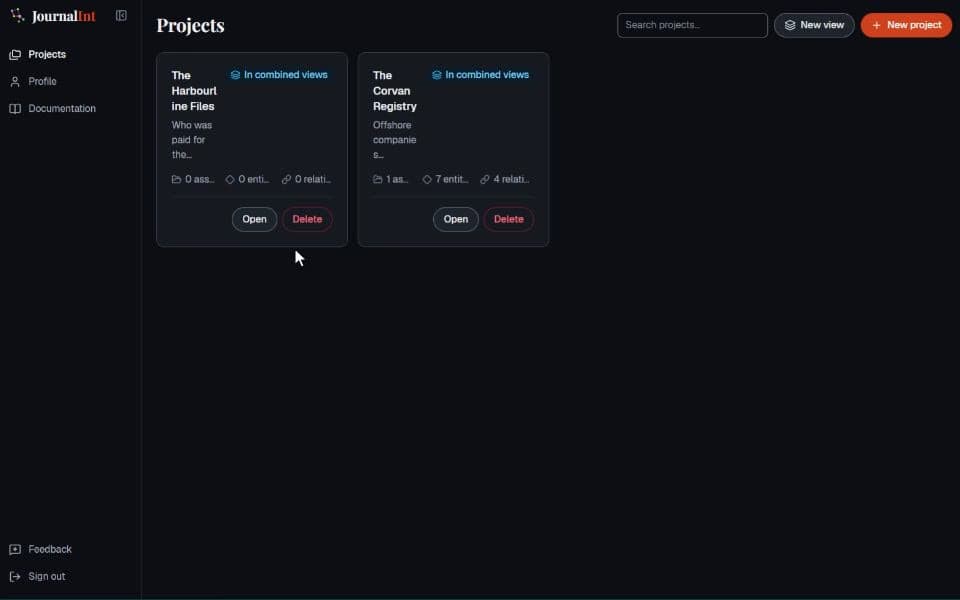
  1. A PDF and a web address ready to upload

    Upload PDFs or URLs

    Upload PDF, DOCX, TXT or Markdown, or paste a web address. Scanned PDFs go through OCR.

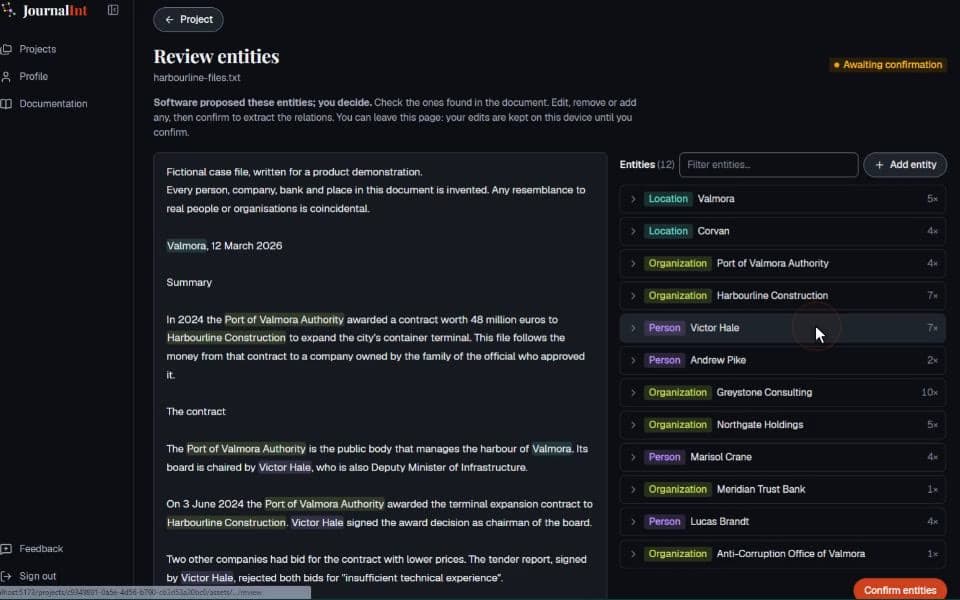
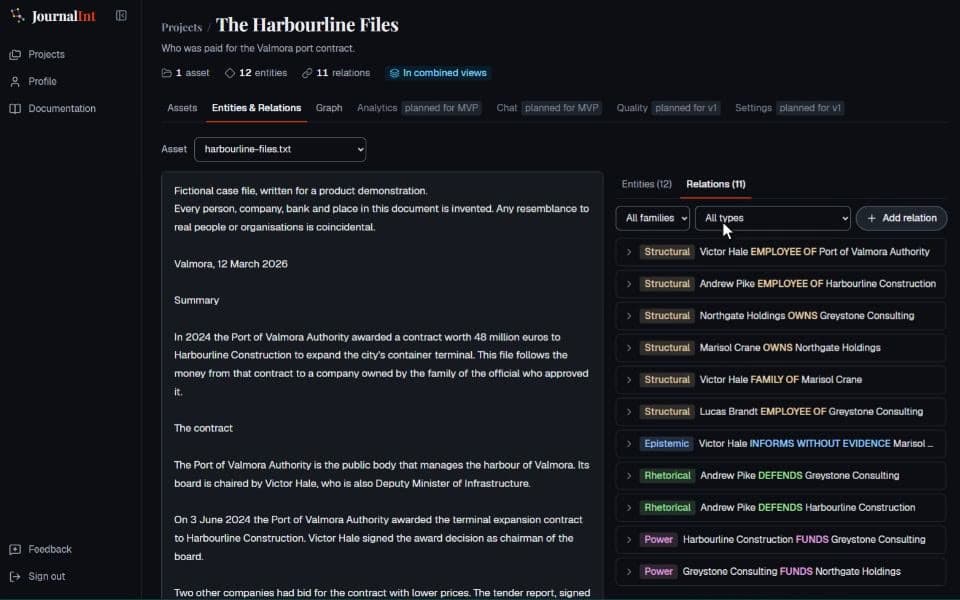
  2. A relation between two organisations next to the sentence of the document that supports it

    Review Each Relation With Its Quote

    The AI proposes the entities and you confirm them. The relations come next, each with the verbatim quote from your document. You correct or delete the ones that are wrong.

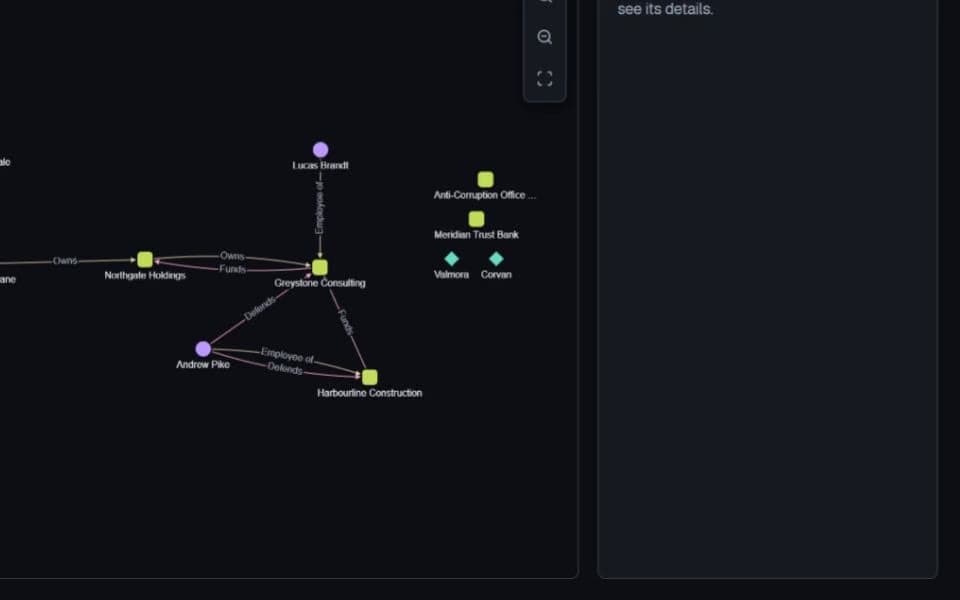
  3. A graph of people, organisations and places joined by relations

    Explore the Graph

    What you have reviewed forms your project’s graph. Every item carries its provenance label.

Watch the Full Demo (2 min)

Who Is It For?

For anyone who has to explain who is connected to whom, and prove it.

Journalists

Little time and unpaid research work

42% of journalists do not usually have enough time.

Source: Muck Rack, State of Journalism 2026

Upload the URLs and PDFs you already have and defend each claim to your editor with its quote.

Newsrooms

More original investigation with fewer resources

A net balance of +91 in favour of more original investigations among 280 news executives.

Source: Reuters Institute, Trends and Predictions 2026

A view that combines your projects, to see who shows up in more than one investigation.

Researchers, NGOs and Fact-Checkers

Financial pressure and the need for traceability when publishing

According to the IFCN survey, 3 in 4 fact-checking organisations are financially vulnerable or in crisis.

Source: IFCN via Duke Reporters’ Lab, 2026

Every relation carries its quote and every item its provenance label, so you can cite with traceability.

Due Diligence

Complex control structures and files that have to be auditable

The EU anti-money-laundering regulation (AMLR, Regulation 2024/1624) applies from 10 July 2027 and requires enhanced due diligence on complex ownership structures.

Source: eucrim, the EU's new AML rulebook; Persona, what the AMLR is (a vendor)

Assisted reading of press and reports, with the quote of each relation for the file.

Why JournalInt?

  • Free tools that find names but not relations: Datashare, Pinpoint and Aleph.
  • Tools that answer without leaving a map: NotebookLM and ChatGPT.
  • Suites at €3,000 to €7,500 per user per year that draw the graph but do not extract it from your documents: Maltego and Linkurious.
  • None of the 14 tools analysed turns your documents into typed relations with the verbatim quote that proves them and a human review.

JournalInt does, and it is free during the beta.

Comparison with other tools
CriterionJournalIntMaltegoDatashareNotebookLMAleph
Does it extract relations from your documents?Yes, typed relationsNoOnly entities and co-occurrenceNo: it answers questions, with no persistent mapNo: entities and public data, no relations extracted from text
A verbatim quote for each relation?Yes, checked against the textNoNo: it links to the documentCites passages, not relationsNo: it links to the document
Human review?Yes: you confirm the entities and correct or delete each relationManual editing of the graphManual editing or taggingNoManual editing or tagging
Price per user per yearFree during the beta€3,000 (Entry, with prior verification) to €7,500 (Professional)Free, open sourceFree with limits; paid plan separateFree for non-profit news organisations; commercial price not published

Sources of the comparison: Maltego, pricing; ICIJ on Datashare’s graph; OCCRP, Aleph Pro FAQ

We give no price for NotebookLM: Google does not publish amounts on its plan pages.

Sources

Trust and Privacy

What JournalInt does with your documents, and what it does not.

  • The Quote, Always

    Every relation is kept with the sentence of your document that supports it, checked against the text. No quote, no relation.

  • The AI Proposes, You Decide

    You confirm the entities before the relations are extracted, and you can correct or delete any of them. Every item carries its label: detected by AI, confirmed by a person or added by a person.

  • Your Account and Files, in the EU

    Your account, your files and your graph are stored in the EU. To extract the relations, the text of your documents is sent to AI model providers based in the United States.

  • No Training

    We use paid accounts with model providers, and training on your documents is not enabled on any of them.

  • Complete Deletion

    When you delete your account, your documents, your graph, your files and the debugging record are removed.

  • Public Material Only During the Beta

    Do not upload leaks or drafts: during the beta, only material that is already published or public.

An extraction is a lead, not a finding. Check each relation before you publish it.

How we extract and what data we keep

Collaborators Wanted

JournalInt is measured against documents that people have annotated by hand. Journalists and researchers can add documents, annotate and review each other’s work, and define the types the product looks for. The work earns points, and points are redeemed for time on the paid plans to come.

20 of 20 seats are open.

What the Work Earns

  • new document, annotated in full55 points, once 3 colleagues have reviewed it
  • blind annotation of someone else's document34 points, at once
  • new definition of a type21 points, once 2 colleagues have reviewed it
  • contribution to an existing definition13 points, at once
  • review of someone else's annotation8 points, at once

What It Takes

  1. about an hour

    55 points: 1 month of the low tier

    • 1 × new document, annotated in full
  2. about 15 hours

    616 points: 1 year of the mid tier

    • 6 × new document, annotated in full
    • 6 × blind annotation of someone else's document
    • 6 × review of someone else's annotation
    • 1 × new definition of a type
    • 1 × contribution to an existing definition
  3. about 40 hours

    1602 points: 2 years of the top tier

    • 18 × new document, annotated in full
    • 12 × blind annotation of someone else's document
    • 15 × review of someone else's annotation
    • 4 × new definition of a type

    This perk also needs 7 of your documents to have been accepted.

Points have no cash value. Perks are reserved until paid plans exist, and the point costs above are provisional until the plans are announced. A perk you redeem keeps the cost you redeemed it at. Read the programme terms.

Request an InvitationAn account comes first; you ask for a seat from your profile.

Frequently Asked Questions

How is it different from ChatGPT or NotebookLM?

An assistant answers a question. JournalInt builds a map: it extracts relations between people, organisations and places, each with the verbatim quote from your document, and what you review forms a graph that is kept. NotebookLM cites passages, but leaves no persistent graph.

Where do the relations come from, and how do I know they are true?

The AI proposes them from the text of your documents, once the entities are confirmed. Every relation carries the verbatim quote, checked against the text. You review it and can correct or delete it. An extraction is a lead, not a finding: check before you publish.

Where are my documents kept? Do you train models on them?

Your account, your files and your graph are stored in the EU. To extract the relations, the text is sent to model providers based in the United States, on paid accounts where training is not enabled. When you delete your account, everything is removed. If you join the collaborator programme, the documents you contribute on purpose are used to measure the extraction.

Which languages does it support?

Today it supports documents in English and Spanish, and we are working to improve the extraction in both. We plan to add French, German, Portuguese, Catalan, Galician and Italian. The web app is in English only for now.

Can I use it with confidential material?

During the beta, only material that is already published or public: do not upload leaks or drafts. An on-premise deployment is planned for sensitive material, and does not exist yet.

How much does it cost?

It is free during the beta, by invitation. We will announce the prices before the launch.

Does it work with URLs and scanned PDFs?

Yes: you upload PDF, DOCX, TXT or Markdown, or paste a web address, and scanned PDFs go through OCR. Audio and video are not processed yet.

Is it an alternative to Maltego?

Not exactly. Maltego is strong at enriching with external data and drawing the graph, but it does not extract relations from your documents. JournalInt does the opposite: it starts from your documents and does not enrich with registries or sanctions lists, which is planned.

How can I extract the relations between people and companies from a PDF?

Upload the PDF to a project. The AI proposes the people, organisations and places that appear, you confirm them and, from there, JournalInt extracts the relations between them, each with the sentence of the document that supports it. If the PDF is a scan, it goes through OCR first.

Can the AI make up relations or quotes?

JournalInt only keeps a relation if it finds the verbatim quote in the text of your document, and it checks that the sentence exists. Even so, the model can misread a sentence and propose a wrong relation: that is why you see it next to its quote and can correct or delete it.

Can I cite in a story what the AI extracts?

An extraction is a lead, not a finding. The quote takes you to the exact sentence in your document, but checking the claim against other sources and deciding what is published remains the journalist’s work.

What tools are there to map the relations in an investigation?

It depends on what you have. Datashare and Aleph find and organise names in large volumes of documents and are free (Aleph, for non-profit news organisations). Maltego draws the graph and enriches it with external data, and is paid. NotebookLM or ChatGPT answer questions about your documents, leaving no map. JournalInt extracts the relations from your documents with their quote and keeps them as a graph.

Request Your Invitation

Seats are limited. Ask for yours and you will get an answer by email.

What you enter here is held by Esteban Sánchez to invite you to the beta, on the basis of this consent, until the beta ends or you ask for it to be removed. It is stored with hosting providers in the EU. Your email address and name also go to an email delivery provider, which sends from the EU, only to email you the answer. It is shared with no one else. To see, correct or delete it, or to withdraw consent, write to . You may also complain to a data protection authority.